
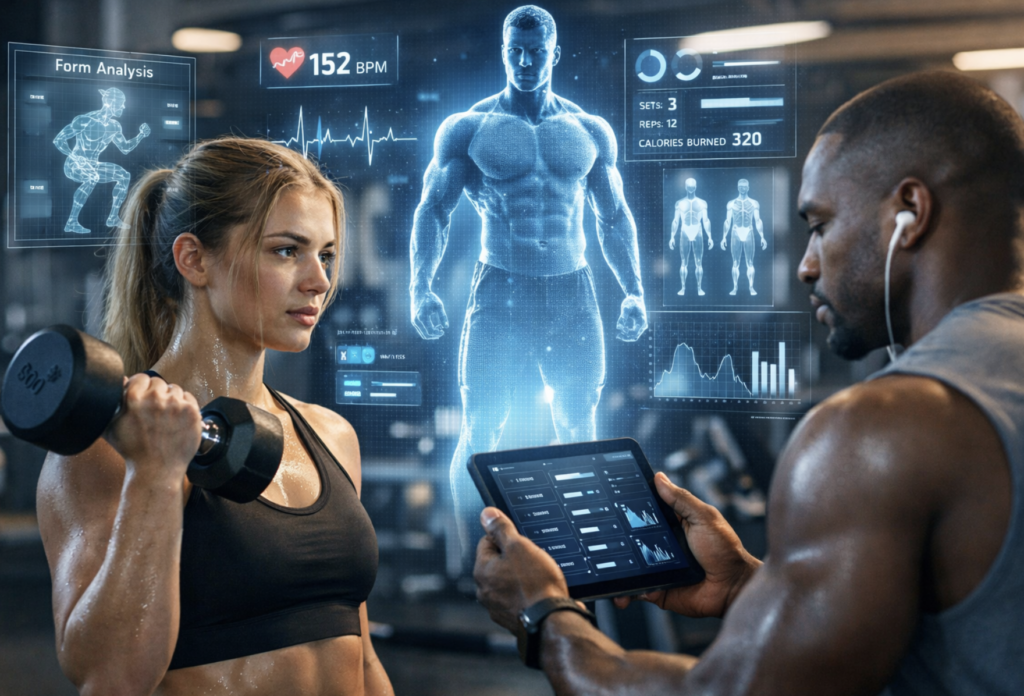
The fitness world is changing fast, and the biggest shift is no longer just better treadmills, smarter watches, or more polished apps. It is the rise of AI workout plans that can build routines in seconds, adjust recommendations based on user input, and promise a level of personalization that used to sound futuristic. That growth makes sense. The American College of Sports Medicine says wearable technology remains the top fitness trend for 2026, with mobile exercise apps also ranking near the top, which shows just how normal tech-based training has become in everyday fitness.
The appeal of AI workout plans is easy to understand. They are fast, accessible, often cheaper than one-on-one coaching, and available at any hour. For someone who feels intimidated by the gym, confused by exercise advice online, or unable to afford regular coaching, that kind of convenience can feel like a breakthrough. And in some ways, it is. But convenience and safety are not the same thing. A plan can be fast, polished, and motivational while still missing the details that keep real people safe when they train. That is where the real conversation starts.
If we are going to talk honestly about this topic, we need to separate two ideas that often get blended together. The first is whether artificial intelligence can create a workout plan at all. The second is whether that plan is appropriate for a specific human body, a specific health history, a specific experience level, and a specific goal. Those are very different questions. A 2024 mixed-methods study on AI-generated exercise recommendations found notable gaps in comprehensiveness, accuracy, and readability, while another critical evaluation of GPT-4 exercise prescriptions found that the model could produce generally safety-conscious plans but often lacked precision for individual needs and goals.
Why the Technology Feels So Impressive
At their best, AI workout plans do something valuable: they reduce friction. Instead of spending hours searching for routines, comparing advice from ten influencers, or guessing how to organize a week of training, users can answer a few questions and receive a structured program almost instantly. That matters because structure often helps people begin, and beginning is where many health improvements start. Public health guidance from the World Health Organization and the CDC recommendations for adults continues to emphasize that any movement is better than none, with adults generally aiming for 150 minutes of moderate activity per week plus muscle-strengthening activity on at least two days. When technology helps more people take that first step, it can genuinely support better health.
Another reason these tools feel smart is that they are often pulling from patterns that many humans overlook. They can organize schedules, estimate training frequency, adapt exercise libraries, and incorporate feedback from wearable devices. That fits neatly with the broader direction of the industry. In the American College of Sports Medicine’s 2026 fitness trends, wearable technology ranked first, and ACSM specifically noted that these tools can support self-monitoring, accountability, and long-term engagement when they are used with care. In other words, AI has the potential to make fitness guidance more consistent and more responsive than a static PDF downloaded three years ago.
It is also fair to say that a digital system can sometimes help people avoid a different kind of danger: random, inconsistent training. Many people hurt themselves not because they had a formal program, but because they had no plan at all. They jump from intense cardio to heavy lifting to trendy challenges without any real progression. Exercise science has long emphasized that progress works best when it is structured, gradual, and aligned with the individual. Even Wikipedia’s page on exercise prescription, while not a clinical authority on its own, points readers to the longstanding concept that exercise should be tailored to the person rather than treated as one-size-fits-all advice. That basic principle is one reason digital guidance can be useful.
Where Safety Starts to Get Complicated
The problem is that AI workout plans can only be as safe as the information they receive, the rules they were built on, and the limits they are designed to recognize. If a user fails to mention a knee injury, high blood pressure, postpartum recovery, joint instability, dizziness, disordered exercise habits, or severe deconditioning, the output may sound confident while being poorly matched to reality. That is not always because the technology is reckless. Sometimes it is because training safety depends on context that people do not know to report. The FDA’s overview of artificial intelligence in medical devices makes a broader point that applies here too: AI systems can be useful, but complex, dynamic technologies require careful management across their life cycle.
Safety in exercise is also rarely about the workout on paper alone. It is about the dose. The same squat, run, push-up, or overhead press can be appropriate for one person and a bad choice for another depending on load, frequency, form, fatigue, recovery, mobility, and medical status. That is one reason exercise professionals still matter. They notice hesitation, movement quality, pain responses, balance issues, and compensations that many digital tools cannot reliably catch. The National Institute on Aging also reminds readers that a well-rounded exercise routine should include aerobic, muscle-strengthening, and balance work, especially as needs change across the lifespan. A plan that looks “complete” because it fills seven days on a calendar may still be incomplete in the ways that actually matter for long-term function and safety.
Many AI workout plans still struggle with the difference between generalized fitness advice and true individual programming. That gap may sound small, but it is where safety often lives. A general routine can tell a beginner to work out four times a week. A safer individualized routine asks whether that beginner has trained before, whether they recover well, whether they sleep enough, whether they are managing pain, and whether they can perform the chosen movements correctly. The recent review literature on AI in exercise continues to show promise, but it also keeps returning to the same caution: these systems are useful for scale and support, yet they are not fully reliable substitutes for expert oversight in more complex or higher-risk cases.
Smarter Does Not Automatically Mean Safer
One of the most common mistakes in modern fitness is confusing responsiveness with wisdom. A system that updates quickly can still update in the wrong direction. If a user reports feeling “fine” after a hard session, an algorithm may progress the workload even when soreness, fatigue, or minor strain should have triggered a more conservative approach. That is especially important because safe exercise progression is supposed to be gradual. Mayo Clinic’s guidance on exercise intensity notes that overdoing it can increase the risk of soreness, injury, and burnout, and suggests gradual progression, often around a 10% increase per week as a general rule. That kind of restraint is not glamorous, but it is often what keeps progress sustainable.
This is where the current marketing around AI can get misleading. A platform may advertise itself as adaptive, personalized, and data-driven, and all of that may be technically true. But being adaptive is not the same as being clinically aware. Being personalized is not the same as understanding pathology. Being data-driven is not the same as understanding what data matters most in a given moment. If a wearable reports heart rate, sleep duration, and training consistency, that can be helpful. But ACSM also cautions that not every wearable metric is equally accurate or equally meaningful, and some measures may still be experimental or unreliable for decision-making.
The same issue shows up in strength training. People often assume that more variables mean a better plan, but newer evidence points in a simpler direction. In ACSM’s updated resistance training guidelines, the organization emphasized that consistency matters more than complicated programming for most healthy adults, and that programs should be individualized around goals, enjoyment, and safety. That matters because some AI tools overcomplicate training to appear advanced, when what many people need most is not novelty but a repeatable, appropriate plan they can recover from.
Who Needs to Be Extra Careful
That is why AI workout plans deserve extra caution when the user is not a healthy, moderately active adult with straightforward goals. Older adults, beginners, people returning after injury, pregnant or postpartum individuals, people with heart or metabolic conditions, and those with chronic pain or major mobility limitations should be especially careful. Public health recommendations repeatedly note that many people can and should be active, but the type and amount of activity may need to be adjusted in consultation with a qualified professional when chronic conditions or higher-risk factors are present. The CDC explicitly advises checking with a doctor before starting vigorous activity in certain situations, and the National Institute on Aging emphasizes choosing activity that fits current ability and health status.
Even among younger and apparently healthy users, there are softer risks that matter. A person with poor body image, obsessive exercise tendencies, or a history of overtraining may use a highly responsive app in ways that reinforce unhealthy behavior rather than balanced progress. A machine can optimize for output, streaks, frequency, and completion, but health is not measured only by compliance. It is measured by whether the body is adapting well, whether pain is ignored or respected, whether recovery is built in, and whether the routine supports life rather than taking it over. Those are human judgments before they are algorithmic ones.
How to Use the Technology More Safely
The safest way to use AI workout plans is to treat them as a starting point, not a final authority. They can be excellent for structure, idea generation, scheduling, variety, and consistency. They can help someone organize a week, stay engaged, and avoid the chaos of random training. But the user still needs to apply judgment. Does the plan match current fitness? Is the weekly volume realistic? Does the progression feel gradual? Is there rest? Is there a warmup? Does pain show up during specific movements? Does the plan consider balance, strength, and aerobic work appropriately for the person using it? Those questions matter as much as the app interface.
Even strong AI workout plans should be checked against basic evidence-based standards. Does the routine align with the broad weekly activity targets from the CDC? Does it reflect the balanced movement categories discussed by the National Institute on Aging? Does it respect the gradual progression cautioned by the Mayo Clinic? Does it avoid chasing complexity when the American College of Sports Medicine says consistency is the more meaningful driver for most adults? If the answer is no, the plan may be smart in appearance but weak in safety.
There is also real wisdom in using a hybrid model. Let the technology handle the convenience, but let a qualified human handle the interpretation. That could mean asking a physical therapist about exercise after injury, checking in with a physician if a medical condition is involved, or working with a certified trainer to review the plan before following it for several months. In many cases, the most practical future is not AI versus coaches, but AI plus professionals. The machine helps with speed and scale; the human helps with judgment, nuance, and accountability. That is a far safer combination than blind trust in automation.
Conclusion
In the end, AI workout plans are becoming more polished, more available, and more useful for millions of people. They can reduce confusion, encourage consistency, and make structured training feel more reachable than ever before. That is real progress, and it should not be dismissed. But smarter tools do not eliminate the oldest truth in fitness: safe exercise still depends on the person, not just the program. Bodies are individual. Risk is individual. Recovery is individual. Goals are individual. A machine may help organize that reality, but it does not erase it.
The best AI workout plans are not the ones that promise perfection. They are the ones that support better decisions, respect gradual progress, and leave room for human judgment where judgment is still needed most. Used that way, they can absolutely be helpful. Used carelessly, they can create a false sense of safety that the body eventually exposes. The future of fitness will almost certainly include more artificial intelligence. The safer future will be the one that remembers health is still human.